
What does a young, struggling artist do when he knows he’s great but he has trouble getting the big commissions he thinks he deserves? In the Renaissance, the strategy might have looked a lot like what is often asked of freelancers today: work for free or cheap, “for visibility”. Tintoretto, facing extreme competition in mid-16th-century Venice, was brilliant at this approach, and it worked.
In this essay we’ll look at two huge, shocking paintings that Tintoretto would paint for his parish church, the Madonna dell’Orto in Venice. He had proposed this to the authorities at a steal: they would only have to pay for materials. Tintoretto’s ambition was to create a sensation by painting some of the tallest canvases of the Renaissance. Would it work?
The artist and the competition
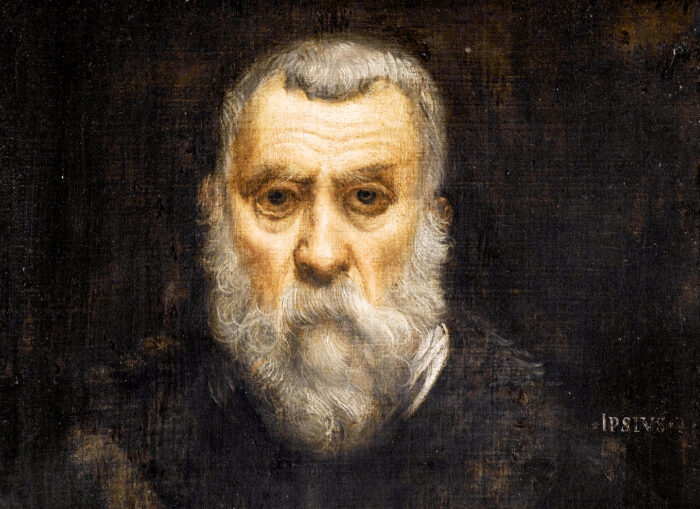
The Venetian high Renaissance is dominated by three great names: Titian, Veronese, and Tintoretto, and there was a fair amount of competition there. Titian was thirty years older than Tintoretto, and it is generally believed that Tintoretto did a stint in Titian’s workshop when he was a teen, but it didn’t last long, “with many speculating it was due to a strong clash of personalities between the old master and the more progressive, exuberant and boundary-pushing personality of the young pupil” (theartstory.org). Titian disapproved of Tintoretto’s style, favouring Veronese, 10 years younger than Tintoretto but with a style more aligned with his own. The artist, Jacopo Robusti (1518–1594), was nicknamed Il Furioso for his extraordinary energy and speed, and eventually his unique style and productive capacity helped him become one of the leading figures of the Venetian Renaissance.
Tintoretto eventually did “make it”: his dramatic works can be found throughout Venice, including in some of the city’s most celebrated landmarks, such as the Doge’s Palace and the Scuola Grande di San Rocco. But the church of Madonna dell’Orto, which houses eleven of his works, his early and very impactful large paintings, and is also his final resting place, is often overlooked.
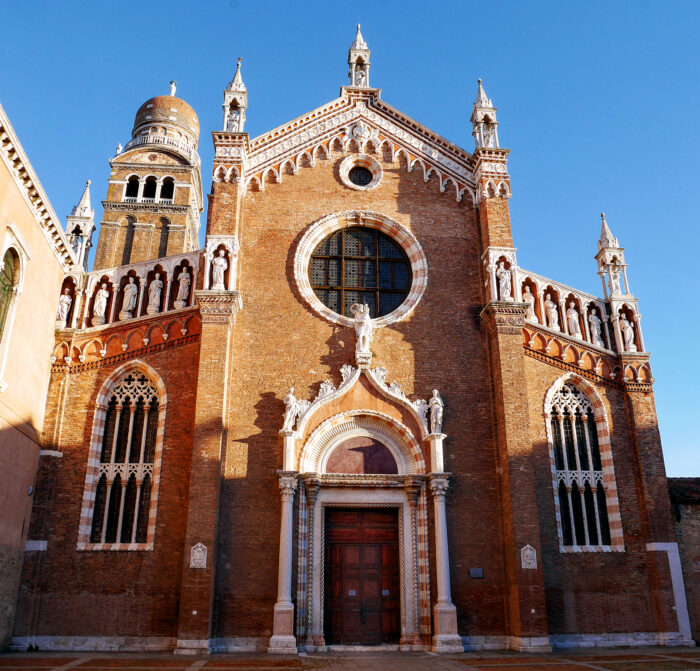
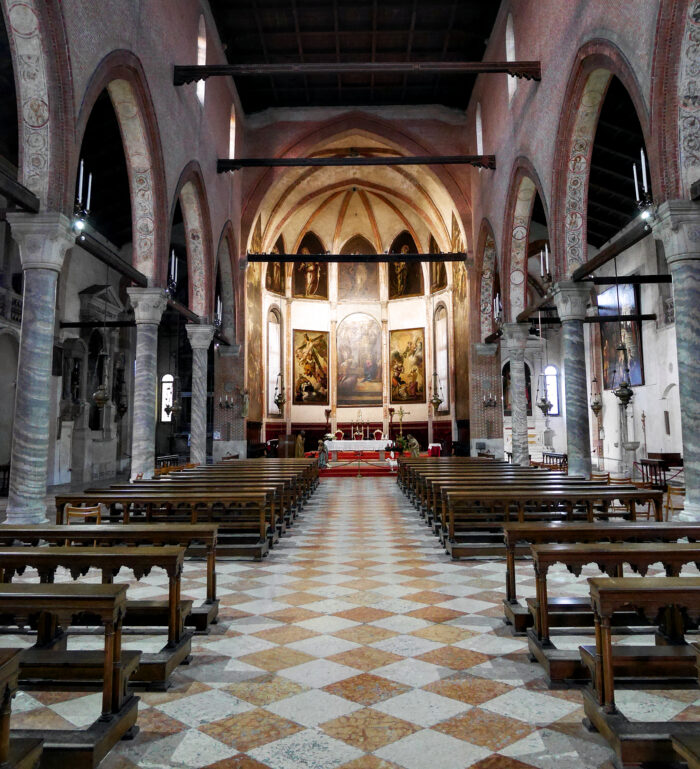
The interior is every bit as captivating. Rows of slender columns in striped Turkish marble divide the nave from the aisles, while a flat, coffered wooden ceiling completes the space. These architectural elements draw the eye towards the altar and the pentagonal apse.
The Adoration of the Golden Calf
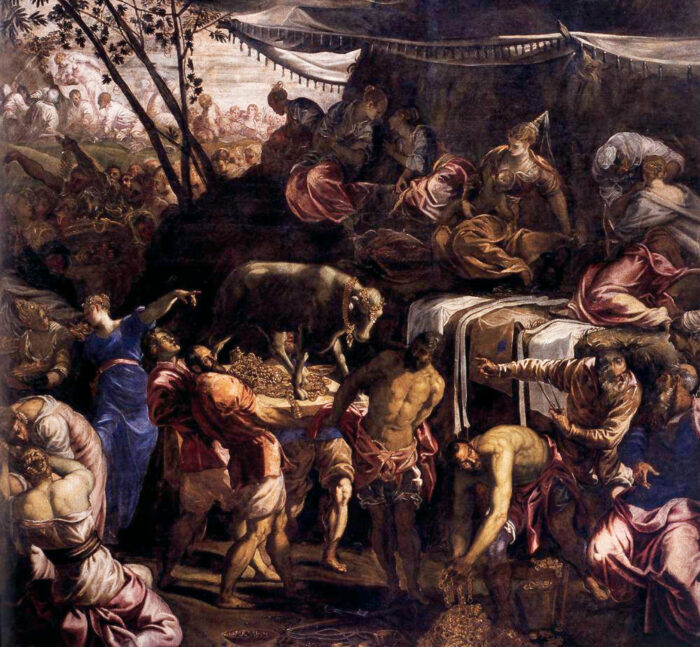
Tintoretto uses the extraordinary vertical format to bring these two very different worlds together: the restless activity of the Israelites below and the radiant, almost otherworldly scene above. The eye is drawn upwards, following the slope of the mountain and the movement of the clouds until it reaches Moses.
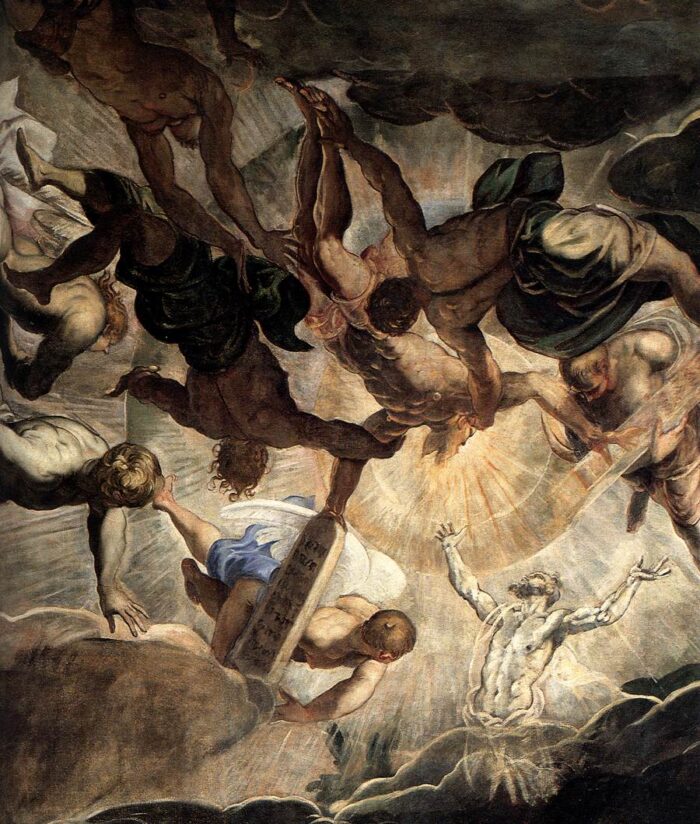
The Last Judgment
On the opposite side of the choir, The Last Judgment is every bit as dramatic, but in a very different way. Here Tintoretto takes the familiar subject and turns it into a vast, almost overwhelming vision of movement. Rather than arranging the figures in neat rows, he sets them into a swirling mass of bodies, clouds, angels and demons, all caught up in the final upheaval of the world.
High above, Christ appears as a judge, with a lily, the symbol of mercy, floating beside one hand and a sword, the symbol of justice, beside the other. The Virgin Mary and Saint John the Baptist flank him, pleading on behalf of humanity. But it is difficult to keep your eyes on this heavenly group for long. All around them, bodies twist and tumble through the clouds, while others rise from the earth below. Tintoretto’s composition seems to have no still point: the whole scene is in motion.
One of its most distinct features is the torrent of water that cuts across the lower part of the painting. It rushes out from the depth of the scene, carrying bodies with it and sweeping around bare trees and a small boat. The boatman is Charon, the figure from classical mythology who ferries the dead into the underworld.
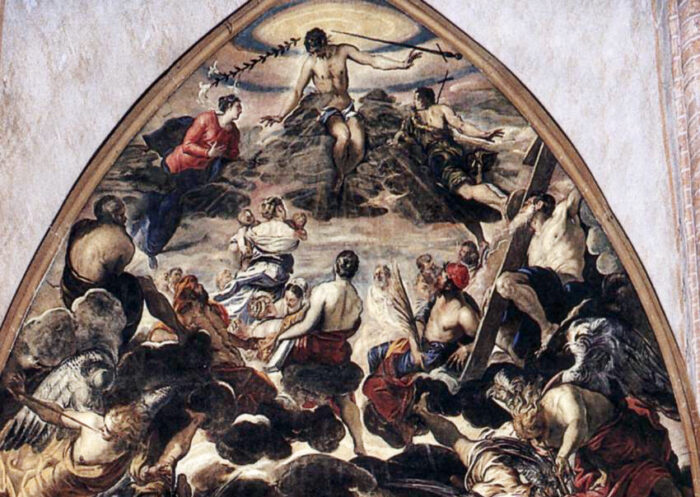
The effect is heightened by the way he handles light. The upper part of the painting is bathed in a brighter, almost supernatural glow, while the lower reaches become progressively darker, particularly around Charon’s boat. This contrast helps establish the different realms within the composition, while reinforcing the sense of a tremendous downward current. The diagonal rush of water seems to come towards us, almost spilling out of the canvas.
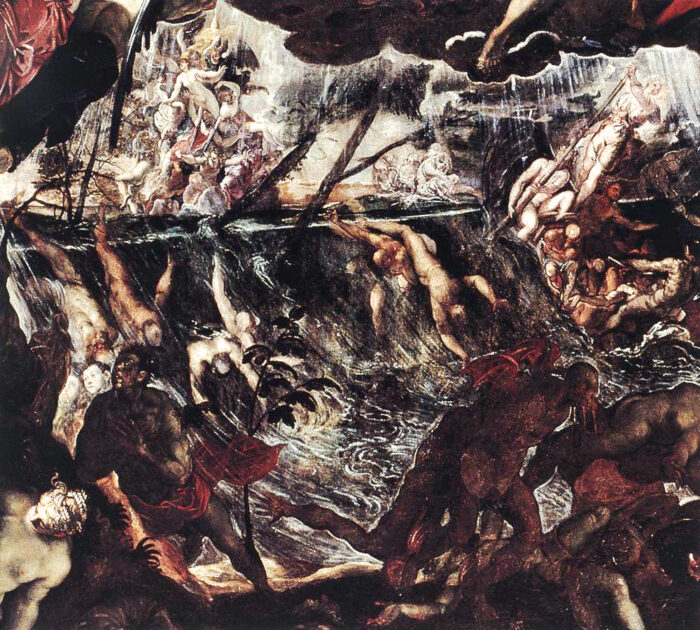
The choice of the Last Judgement begs comparison with Michelangelo’s fresco of the same in the Sistine Chapel (1536–1541). Tintoretto must have been deliberately making this comparison, but he also does this in a truly Venetian and personal manner. As we just noted, the scene is rendered almost as a flood, something the Venetian public can understand. But there’s also a typically Venetian verticality to the scene: while Michelangelo’s figures revolve in a slow reel up and down towards Christ at the center, Tintoretto created a steep, slanting waterfall of clouds and bodies that appears to pour downward directly over the viewer. And within all this is the discourse of Colorito versus Disegno that was ongoing between Venice (colorito) and the rest of the world – if Michelangelo was all muscles, Tintoretto is atmospheric depth, a lack of solid contours, rapid brushstrokes and bursts of light.
Seeing the paintings in situ
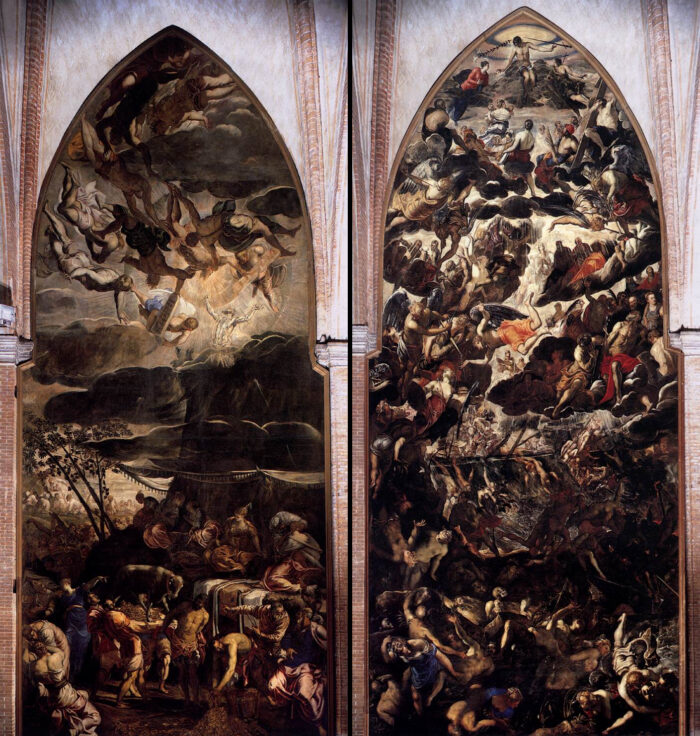
Seen together, the two paintings make a remarkable pair. On one side, humanity turns away from divine law to create an idol of its own making; on the other, humanity faces the ultimate judgment. There is even a subtle visual echo between them: the diagonal line of the torrent in The Last Judgment answers the sloping awning that shelters the women in the opposite painting.
Did Tintoretto succeed in his endeavour to make something so huge and flashy that he’d out-do his contemporaries? Carlo Ridolfi, in his seventeenth-century Life of Tintoretto, would later describe these paintings as “most conspicuous commission in the city.” The human body dominates, contorted into many shapes. Jessica Maratsos in her article “The offense of Romanitas” (in the journal Confraternitas, Vol. 21, No. 2, pp. 43–51) however reflects that “It is likely that this commission would have been very much in the minds of Tintoretto’s potential patrons in the early 1560s, and might account for the resistance to his employment at San Rocco in 1564.”
Vasari, who will always champion Michelangelo, wrote the following about Tintoretto’s Last Judgement:
“In the same church [Santa Maria dell’Orto], on the right-hand wall of the high altar, Jacopo Tintoretto painted a Last Judgment: a fanciful [or extravagant] invention… If this fanciful invention had been executed with correct and regular design (disegno)… it would have been a most stupendous work. At a first glance one is astounded, but on careful examination it looks as if it were painted in jest.”
The artist El Greco, who studied in Venice around 1570 and who was greatly influenced by Tintoretto, wrote hand-written marginalia in his copy of Vasari praising Tintoretto – though not this specific work. He cites “The picture that Tintoretto has made for the hospital of San Rocco” as the best painting in the world today.
Tintoretto did get the commission at San Rocco, but perhaps not the way he’d have liked to. If at the Madonna dell’Orto he worked essentially for free to get himself seen, at the Confraternity he was expressly excluded from the competition and turned to methods even the best communications agency of the modern day might not think of: he placed a completed painting of the Apotheosis of St. Roch in the space by night, and then “donated” the painting as a loss leader that would get him the rest of the commissions in this space. He pulled off another “freebie” years later for the Chapter room, and overall would paint there at a major discount for the rest of his life. In modern terms, he undercut the competition. Was it a win for him?
Visitor information
Chiesa della Madonna dell’Orto
Cannaregio, 3512, 30121 Venezia VE, Italy
Opening hours: Monday–Saturday, 10:30 am–5 pm. Closed to visitors on Sundays (open for services).
Admission: Free.
Further visitor information: Madonna dell’Orto on CityScrolls